Get your complimentary, real-time CEO dashboard with our monthly engagement plans - a level of insight you won’t find anywhere else !


Tax Revenue: The Missing Link in Bangladesh’s Growth Story
Funding the Next Stage of Tax Growth
Ozmo Tax Team
6/1/20264 min read
Why it matters:
In Bangladesh’s ambition to transform into an upper‑middle‑income economy, taxes are not mere obligations, they are an enabler of sustainable development. But with one of the world’s lowest tax‑to‑GDP ratios, the country faces significant barriers in funding infrastructure, human capital, and resilience against shocks. This article explores the current status, policy landscape, structural challenges, areas of opportunity, and a strategic path forward, grounded in recent empirical insights.
Current Status
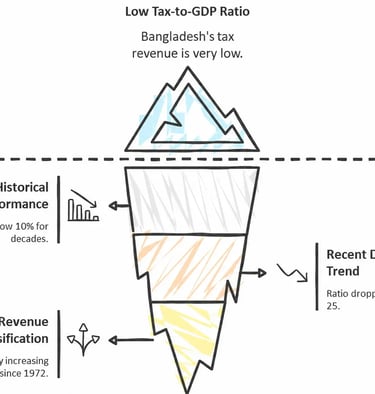
Persistently low tax‑to‑GDP ratio
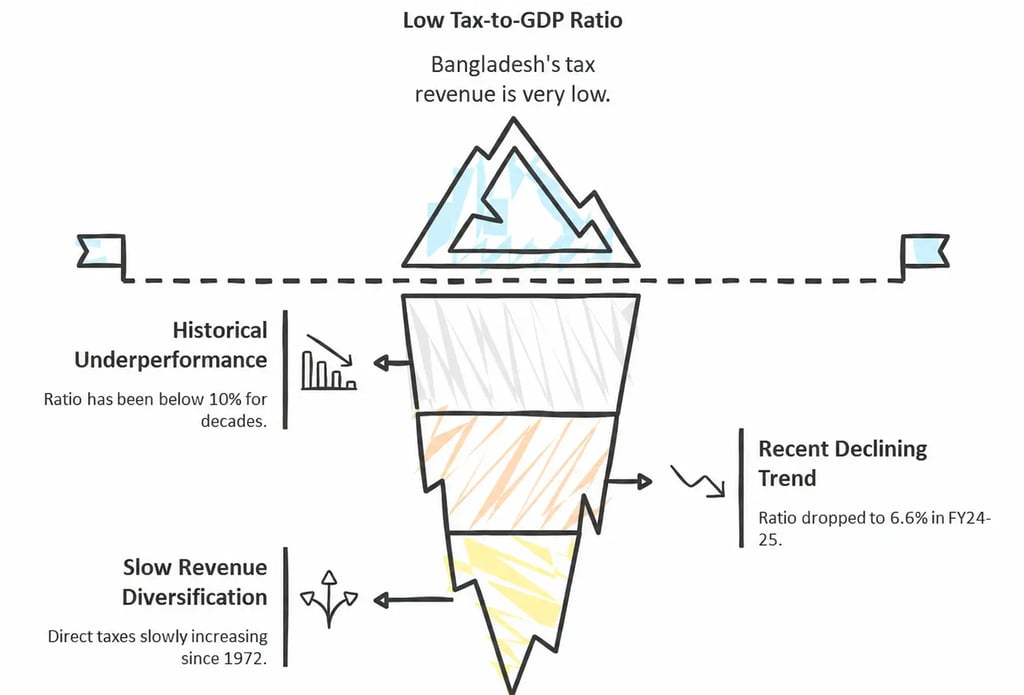
Bangladesh's tax‑to‑GDP ratio has hovered below 10% for decades hovering around 7–8% despite many reform efforts Wikipedia+5Rajawali Institute+5Rajawali Institute+5. In 2023, the OECD recorded Bangladesh at 7.3%, the lowest among Asia‑Pacific countries The Daily Star+1.Recent downward trends
The fiscal year 2024‑25 saw a further decline, with the ratio dropping to 6.6%, raising alarm among policymakers World Bank Data+8Views Bangladesh+8The Financial Express+8.Tax composition shifts
Direct taxes now make up 34.3% of total tax revenues (FY 23–24), up from just 9.7% in 1972–73 reflecting slow progress toward diversifying revenue sources National Board of Revenue.
Governance & Policy Landscape
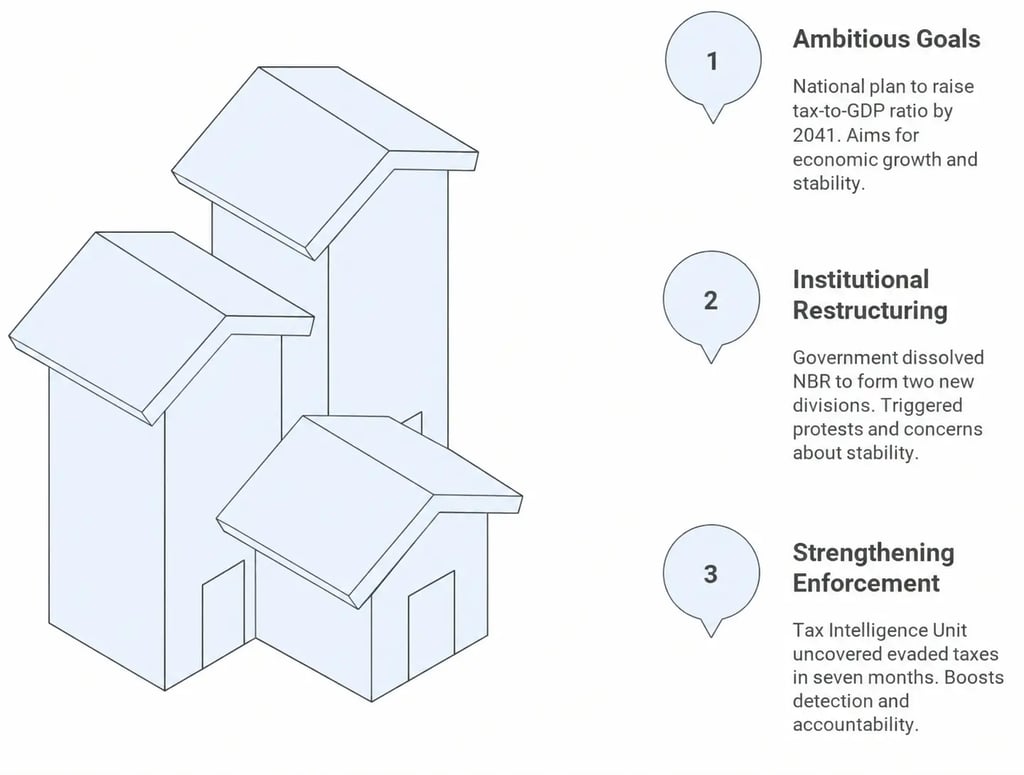
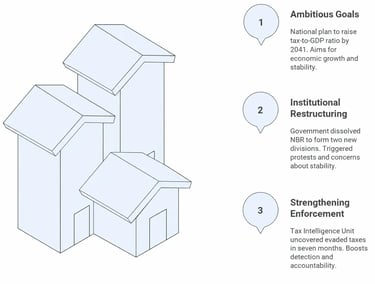
Ambitious goals under Vision 2041
Bangladesh's national development plan aims to raise the tax‑to‑GDP ratio to 15% by 2041 National Board of Revenue+14Wikipedia+14Rajawali Institute+14.Institutional restructuring underway
In 2025, the government dissolved the NBR to form two new divisions Revenue Policy and Revenue Management to overhaul revenue administration Rajawali Institute+7Adam Smith International+7Wikipedia+7. However, this triggered protests and a strike by NBR officials, disrupting operations and raising concerns about institutional stability Wikipedia.Strengthening tax enforcement
The Income Tax Intelligence and Investigation Unit, launched in late 2023, has already uncovered Tk 1,874 crore in evaded taxes in just seven months boosting detection and accountability Wikipedia+2bea-bd.org+2.
Structural Challenges
Revenue mobilization remains weak
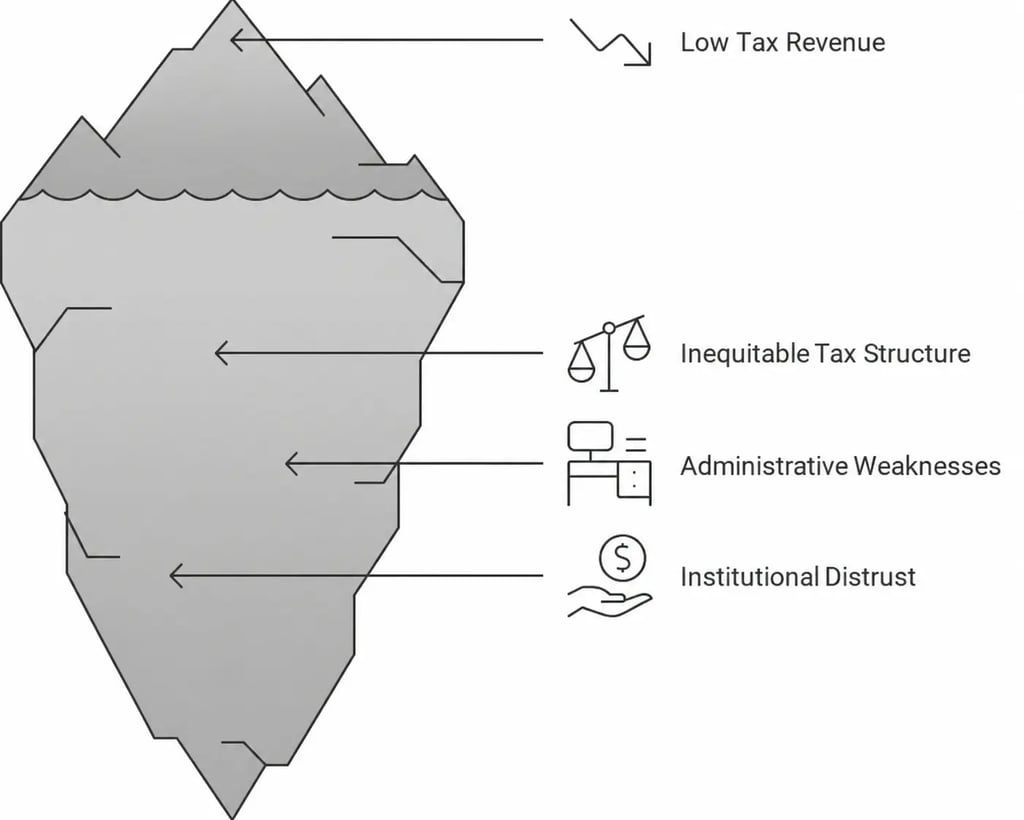
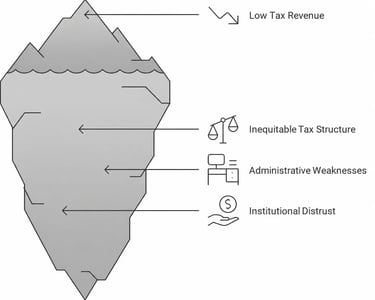
Despite continuous reform pledges since the 1990s, the tax‑to‑GDP ratio has barely budged averaging just 6–8% across decades OECD+15Rajawali Institute+15theigc.org+15. The IMF repeatedly underscores that low tax revenue constrains public investment and development objectives Tax Expenditures Lab+1.Inequitable tax structure & rising inequality
Heavy dependence on indirect taxes (VAT, customs) disproportionately affects lower-income groups. Research links this tax structure to widening income inequality, and advocates shifting toward more progressive, inclusive tax policies bea-bd.org.Administrative weaknesses & institutional distrust
Complex procedural systems, weak enforcement, and low taxpayer morale exacerbated by perceptions of corruption have weakened voluntary compliance. Surveys reveal frequent demands for bribes during tax administration activities Wikipedia.
Opportunities & Path Forward
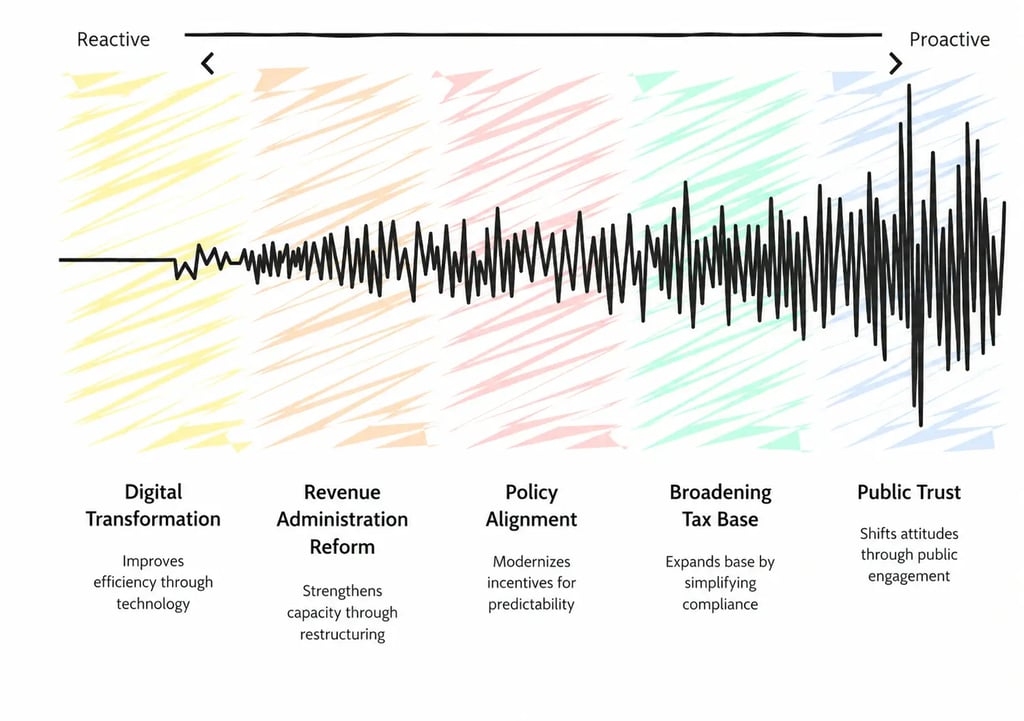
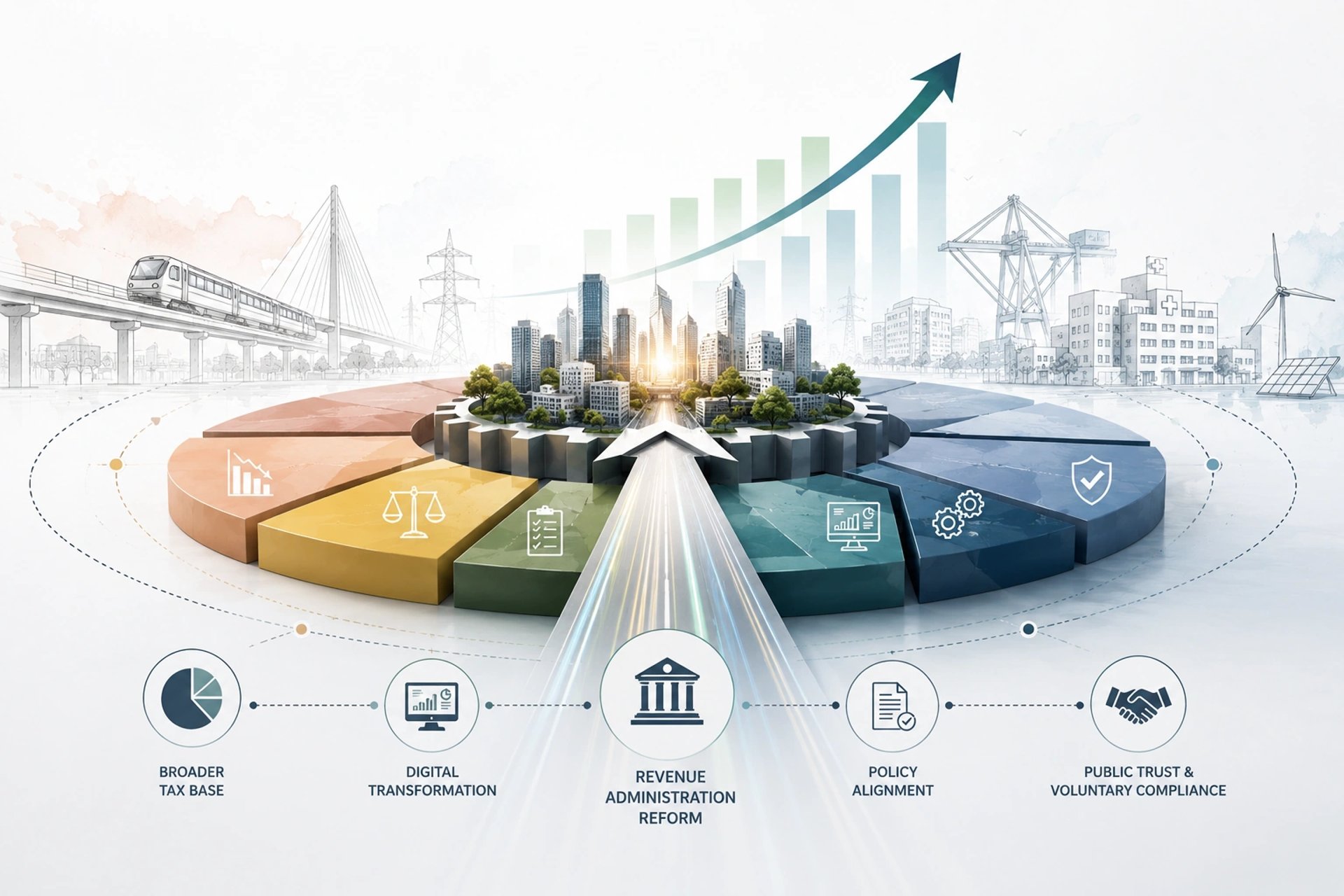
Digital transformation
Scaling e‑filing, mobile interfaces, and risk‑based audit systems could reduce leakages and improve compliance efficiency.Broadening the tax base
Simplifying compliance and formalizing SMEs can expand the tax base. The IT sector model granting tax exemptions in exchange for timely return filing demonstrates a way to combine policy incentives with compliance National Board of Revenue.Revenue administration reform
Institutional restructuring, coupled with better-trained staff and technology-supported enforcement, can strengthen revenue mobilization capacity Wikipedia+5Wikipedia+5Rajawali Institute+5.Policy alignment and modernization
Replacing discretionary exemptions with transparent, rule-based incentives can improve predictability and fairness, encouraging long-term investments Rajawali Institute+1.Public trust & compliance culture
Public engagement campaigns that frame taxes as contributions to collective progress can shift attitudes. Success in other countries—like Vietnam doubling its tax-to-GDP ratio within a decade shows reform paired with transparency works.
Conclusion: A Strategic Imperative
Bangladesh stands at a crossroads. To meet its aspirations under Vision 2041, graduation to high-income status and enhanced economic resilience and it must significantly enhance domestic revenue. Strengthening institutional capacity, modernizing tax policies, improving administrative efficiency, and restoring taxpayer trust are essential steps toward building fiscal sustainability.
In essence, taxes must transform from a compliance burden to a foundation of inclusive, transformative growth.
_______________________________________________
References
Rajawali Foundation, Harvard Kennedy School (2025). Policy Brief: Fixing the Tax System in Bangladesh.
https://rajawali.hks.harvard.edu/wp-content/uploads/sites/2/2025/02/241367-HKS-Policy-Brief-2-Tax-FINAL.pdfThe Daily Star (2024). Bangladesh’s tax-to-GDP ratio lowest in Asia-Pacific: OECD.
https://www.thedailystar.net/business/news/bangladeshs-tax-gdp-ratio-lowest-asia-pacific-oecd-3939831Views Bangladesh (2025). Bangladesh’s tax-GDP ratio drops to 6.6% in 2024-25 fiscal year.
https://viewsbangladesh.com/bangladeshs-taxgdp-ratio-drops-to-66-in-202425-fiscal-year/National Board of Revenue (NBR) (2025). Medium- and Long-Term Revenue Strategy (MLTRS) Report.
https://nbr.gov.bd/uploads/publications/Final_Version_of_MLTRS_NBR_0425_Report_21.04_.25_.pdfWikipedia (n.d.). Bangladesh Vision 2041.
https://en.wikipedia.org/wiki/Bangladesh_Vision_2041Adam Smith International (2025). Fixing the Tax System in Bangladesh: A Long Road Ahead.
https://adamsmithinternational.com/articles/fixing-the-tax-system-in-bangladesh-a-long-road-ahead/Wikipedia (2025). 2025 NBR strike.
https://en.wikipedia.org/wiki/2025_NBR_strikeWikipedia (2025). Income Tax Intelligence and Investigation Unit.
https://en.wikipedia.org/wiki/Income_Tax_Intelligence_and_Investigation_UnitTax Expenditures (2024). IMF mission to help Bangladesh assess tax expenditures.
https://www.taxexpenditures.org/2024/03/12/a-tax-policy-mission-of-the-imf-to-help-bangladesh-assess-tax-expenditures/Bangladesh Economic Association (2024). Tax Structure and Inequality in Bangladesh.
https://bea-bd.org/assets/articlesPhoto/Page_20240607200328.pdfWikipedia (n.d.). Corruption in Bangladesh.
https://en.wikipedia.org/wiki/Corruption_in_Bangladesh